
Runway vs Red Carpet: Why the Same Look Reads Differently
A garment can appear severe on a runway and celebratory on a red carpet. Its colour and proportions may seem to shift even when the clothing has not…
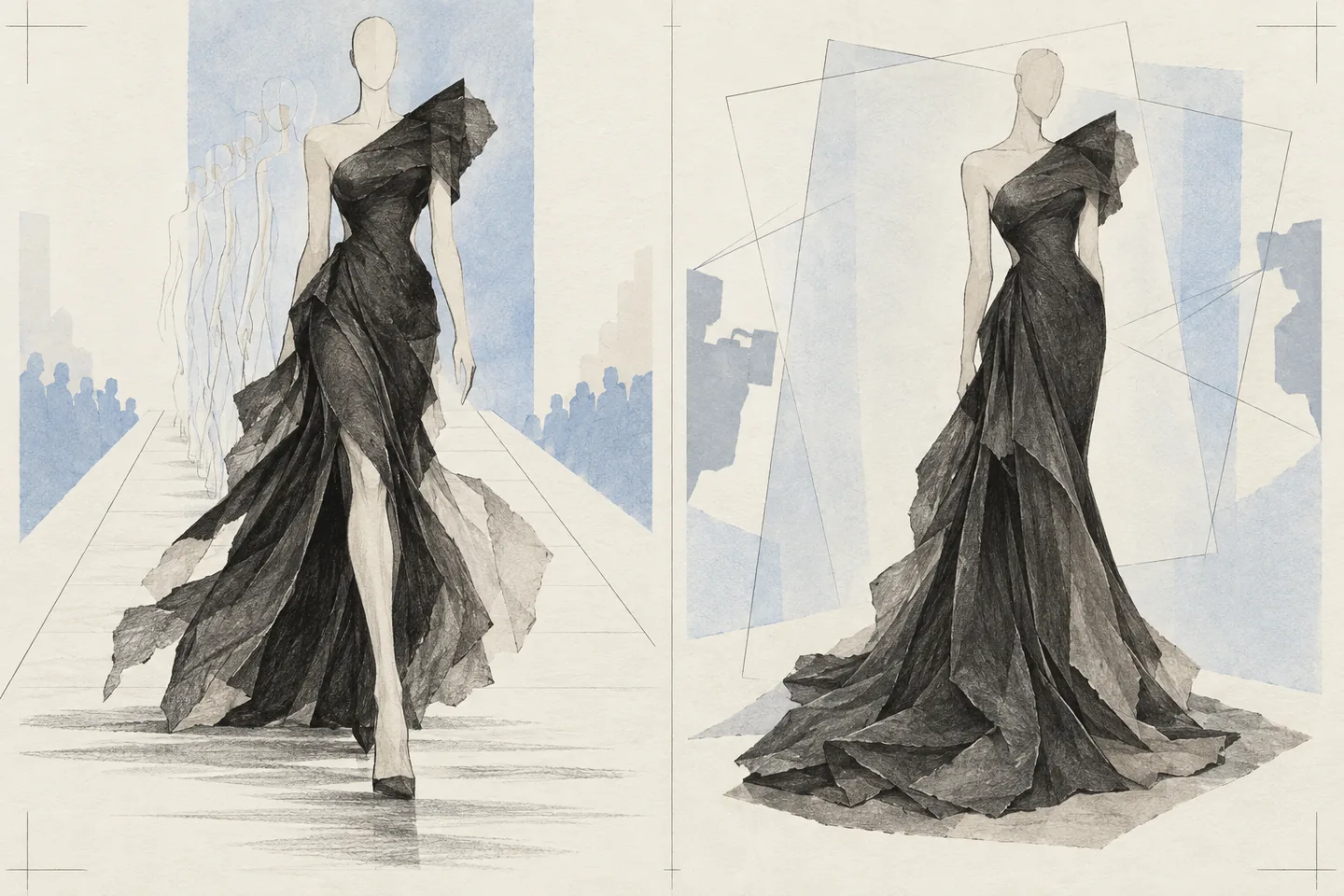
A garment can appear severe on a runway and celebratory on a red carpet. Its colour and proportions may seem to shift even when the clothing has not changed. A moving model becomes a person pausing for photographers; a show’s visual sequence becomes a single arrival; a controlled backdrop gives way to a venue with its own lighting and rules.
Before deciding that a look was “softened” or “made wearable,” separate what the images show from what their settings suggest. A photograph can establish a visible hem, accessory or pose. It rarely establishes why a stylist chose it.
Two settings, two ways of seeing
On a runway, a look belongs to a collection. Its position in the show, the garments before and after it, the model’s movement and the presentation’s lighting all help frame its meaning. A long, continuous view can make the line of a coat or dress legible as it moves. A dramatic shape may make sense beside other shapes developed throughout the show.
On a red carpet, the look is usually encountered through selected photographs: a front view, a turn, a close-up, perhaps an image of the wearer entering the venue. The background includes other people, barriers, signage and the architecture of the event. Even when the garment is recognisably the same design, the viewer receives a different set of evidence. A runway photograph might favour its outline; a carpet close-up might favour the wearer’s face, jewellery and bodice.
The body presenting the garment matters too. In an account of its Costume Institute displays, The Metropolitan Museum of Art explains how pose, body form, styling and scenography affect the presentation of clothing. Its discussion concerns exhibitions rather than red carpets, but it offers a useful reminder: the form supporting a garment and the setting around it are part of what a viewer perceives. The Met also notes that theatrical runway designs can pose particular challenges when transferred to a mannequin. A garment’s appearance cannot be read independently of the body and display conditions that give it shape.
What the camera changes
Pose can redraw a silhouette without a stitch being altered. Walking pulls fabric in one direction; standing distributes it in another. A hand at the waist interrupts a clean side line. A turned shoulder can make an asymmetric neckline more prominent, while a straight-on photograph may flatten it. For a comparison, look for several frames from each setting before treating one striking image as the complete account of the garment.
Camera height and distance also change emphasis. A low angle can enlarge a skirt or make a shoulder appear more commanding. A close crop may remove the train that defined the runway look. Neither photograph is necessarily misleading; each answers a different visual question. The first task is to identify what falls outside the frame.
Colour requires similar care. Different light sources and camera settings can change how fabric appears in a photograph. Adobe’s explanation of white balance describes how lighting can give a white object a blue cast and how colour balance affects all the colours in an image. If a carpet image makes a silver surface look warmer than it did on the runway, that alone cannot prove the material was changed. Compare reliable views and credits before making a claim about the garment itself.
A documented look, with a clear limit
Thierry Mugler’s fall 1995 couture “gynoid” design offers a vivid example of a runway idea seen again at a premiere. Vogue’s account of Zendaya at the London premiere of Dune: Part Two identifies the chrome-and-Plexiglass bodysuit, describes its appearance in Mugler’s couture presentation on model Nadja Auermann, and credits the runway image to the Condé Nast Archive and its red-carpet image to Getty Images.
Those credits support a comparison of two documented presentations of the design. They do not, by themselves, establish that the object photographed in 1995 and the one worn at the premiere are the same physical specimen. Nor does a difference between two photographs establish an alteration. That distinction is especially important with an archival look: “the same design,” “the same type of suit” and “the same garment” are progressively stronger claims.
In the runway account, the suit forms part of a theatrical couture presentation. At the premiere, it is read against a public arrival and the wearer’s appearance in photographs. Its reflective structure remains central in both descriptions, yet the frame changes the question a viewer asks. On the runway, the design can be read as one statement within Mugler’s collection. On the carpet, it becomes the focus of a particular arrival. That is an observation about context, not evidence of anyone’s private intention.
The published images show the design on Auermann and Zendaya in different settings. They cannot establish whether panels, fastenings or internal fit changed. Comparing accessories or hair requires clear views of both presentations; a visible difference still does not reveal who requested it or why.
Fit is visible; alterations need proof
Clothing responds to the person wearing it. Height, posture and the placement of a waist or shoulder affect where fabric falls. Footwear can change the apparent length of a hem; standing still can make a structured garment seem more rigid than it did in motion. These are reasons to examine fit closely, not reasons to assume tailoring occurred.
For a specific look, compare full-length front, side and back views where available. Ask whether a seam, closure or panel has visibly moved, and whether lighting or pose could explain the apparent difference. If a garment is described as custom or altered in a reliable credit or interview, report that description precisely. If no such account exists, describe the visible fit without turning it into a claim about what happened in the workroom.
The venue enters the frame
A runway show can make space for a silhouette as part of its staging. A red-carpet appearance must also fit the route, entrance and event that follow the photographs. Those conditions vary by venue. The Festival de Cannes FAQ, for example, says that voluminous outfits, particularly those with large trains, are not permitted when they impede guest movement or complicate theatre seating. That is a specific published rule for Cannes, not a rule for every carpet.
It demonstrates why the photograph is only one part of the presentation. A long train can occupy a runway beautifully yet present a different question when the wearer must move through a crowd and sit for a screening. Equally, a carpet image of a compact silhouette does not prove that a train was removed to satisfy a rule. Establish the event, its applicable guidance and the garment’s documented details before connecting one to the other.
How to read a look across both settings
Start with identity: designer, collection and look, then the event and wearer. Check the credits attached to each photograph. Next, compare like with like where possible: full-length images at similar angles before close-ups. Record the garment’s visible structure separately from its accessories, hair, pose and background. Treat colour differences cautiously when lighting and white balance are unknown.
Finally, mark what cannot be established. A museum exhibition illustrates the value of viewing clothing through more than one kind of record: The Museum at FIT’s Lauren Bacall: The Look brought garments together with photographs, magazine features and archival footage. The same principle helps with runway and carpet comparisons. A still image, moving footage and a garment credit each answer different questions; none should be asked to prove more than it can show.